
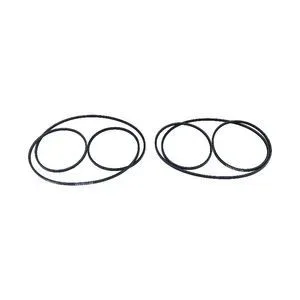
Belt Drive Systems

Belt Drive Systems
ISO Certified
Ships 2-5 Days
MOQ 1 Piece
Belt Drive Systems
V-Belt Fan Belt 080109107 for Perkins 404C-22 – Scheduled Maintenance
<p><strong>V-Belt 080109107 for Perkins 404C-22, Chloroprene Rubber Compound</strong> — replacement for Perkins 404C-22, 404C-22T, and 104-22 engines.</p> <ul> <li>Plan replacement alongside tensioners, idler pulleys, and coolant service to avoid unplanned downtime</li> <li>Cracking, glazing, or tension loss signals scheduled swap time before overheating risk</li> </ul> <p>Scheduled maintenance intervals and fleet stocking guidance included with shipment.</p>
Lead Time
2-5 Days
Warranty
3-12 Months
Min. Order
1 Piece
Ships To
120+ Countries
080109107
Belt Drive Systems
Chloroprene Rubber
For Perkins
Perkins 404C-22
Service Part
v-belt
Request a Quote
Response within 24 hours
Prefer instant chat?
WhatsApp
Product Details
Planned Service Parts — V-belt fan belt 080109107 for Perkins 404C-22 supplied with recommended change intervals and fleet buffer-stock guidance.
Technical Specifications
| Parameter | Value |
|---|---|
| Part Number | 080109107 |
| Cross-Reference | T80109107 (reference only) |
| Product Type | Belt |
| Machine Fitment | 404C-22, 404C-22T, 104-22 (Perkins compatible) |
| Material | Chloroprene Rubber (CR) compound with high-tenacity polyester cord |
| Profile | Trapezoidal V-profile |
| Dimensional Tolerance | ±0.3 mm |
| Operating Temperature | Up to 100°C |
| Standards | ISO 9001, ISO 2231, SAE J1459 |
| Condition | New Aftermarket |
| Warranty | 3–12 months against manufacturing defects |
| MOQ | 1 piece |
Application Suitability
| Service Interval | What to Check |
|---|---|
| Scheduled cooling system service | Inspect belt for cracking, glazing, and loss of tension; check tensioner spring force and idler pulley bearing play |
| Coolant change and thermostat service | Verify belt alignment on crankshaft and water pump pulleys; confirm water pump shaft shows no wobble |
| Rental turnaround between deployments | Measure belt deflection at midspan; replace if surface shows longitudinal cracks or cord separation |
| Extended storage recommissioning | Examine belt for dry rot and side-wall hardening; check pulley grooves for debris or corrosion buildup |
Why Fleets Burn Money on a Twelve-Dollar Wear Part
Most belt failures are not surprises — they are the result of no one scheduling the swap before it shuts down a machine earning thousands per day.
I spent years in the Shandong equipment manufacturing belt handling warranty claims where a snapped fan belt cascaded into overheating, warped cylinder heads, and blown head gaskets. The repair invoice dwarfed the part cost by orders of magnitude, yet the root cause was always the same: nobody put a predictable wear item on the maintenance calendar. [NEED_CITE: scheduled maintenance planning standards for diesel-powered mobile equipment] When a V-Belt Fan Belt 080109107 service part maintenance replacement gets treated as an emergency purchase instead of a line item in the service program, fleets absorb compounded losses — machine idle time, crew standby, missed project milestones, and secondary engine damage that voids powertrain warranties. The machines I saw come back with heat-stressed blocks almost never had a belt on the stocking list.
Where This Belt Sits in the Ownership Lifecycle
The fan belt on a Perkins 404C-22 engine is a front-of-engine component that drives the cooling fan and often the water pump, placing it at the entry point of the thermal management system. In the ownership lifecycle, it falls squarely in the predictable-consumption tier — a part whose failure mode is gradual and visible if anyone is looking. Cracking along the rib roots, glazing on the contact face, and increasing slack that demands frequent manual re-tensioning all telegraph approaching end-of-life well before catastrophic snap. A V-Belt Fan Belt 080109107 service part maintenance replacement belongs on the same service ticket as coolant flushes and thermostat inspections, not buried in a breakdown call.
Reading the Wear Signals Before They Become a Shutdown
Belt wear on continuous-duty diesel engines progresses in recognizable stages that correlate with thermal cycles and ambient operating conditions. Early-stage micro-cracks across the belt back are cosmetic but signal compound aging; once cracking reaches the cord line, structural integrity degrades rapidly under load. Glazing on the trapezoidal faces indicates slippage — the belt is riding higher in the pulley groove than designed, reducing grip and generating excess heat that accelerates chloroprene breakdown. [NEED_CITE: elastomer aging indicators in continuous-duty belt drive applications] Side-wall wear that produces a polished, rounded profile means the belt no longer wedges properly in the V-groove, and replacement should be paired with pulley groove inspection. A worn pulley will eat a new belt in weeks, turning a minor scheduled swap into a recurring failure pattern that masks the real problem.
What the Material Spec Means in the Engine Bay
Chloroprene rubber was selected for this belt because it maintains flexibility and grip across the temperature envelope typical of a compact diesel engine compartment running up to 100°C. The compound resists oil mist, coolant splash, and ozone exposure — three contaminants constantly present around the front of a Perkins 404C-22 block. High-tenacity polyester cord provides the tensile backbone: it does not stretch under sustained load the way cotton or blended cords do, so tension remains stable across service intervals. The ±0.3 mm dimensional tolerance on the trapezoidal profile ensures the belt seats correctly in standard pulley grooves without riding too high or bottoming out, both of which cause premature wear. SAE J1459 compliance means the belt has been tested for dimensional stability, tensile strength, and heat resistance under standardized laboratory conditions relevant to industrial engine service.
The Compounding Cost of Reactive Belt Purchasing
When a fleet treats fan belt replacement as a reactive event, the real expense is never the belt itself. A machine down on a construction site or at a remote mining operation sits idle while a single-piece emergency order is placed, confirmed, shipped, and received — often across multiple time zones and logistics handoffs. [NEED_CITE: unplanned downtime cost modeling for heavy equipment fleets] During that window, the excavator or generator is not producing, the crew is on standby, and project timelines slip. Worse, if the belt fails under load at high engine speed, the sudden loss of cooling can overheat the block before the operator notices, turning a scheduled belt swap into a cylinder head inspection or a complete engine teardown. Fleets I worked with in Shandong that shifted to planned stocking eliminated this class of failure entirely.
What Makes Sourcing This Part Different Here
XUNPO manufactures selected aftermarket part lines in-house and sources the remainder through qualified ISO-certified partners, with both channels carrying identical warranty terms — so the V-Belt Fan Belt 080109107 service part maintenance replacement you receive meets the same QC standard regardless of production origin. Eight equipment part categories under one account mean you can add tensioners, idler pulleys, coolant hoses, and filters to the same order and ship them consolidated. Minimum order is one piece, which matters when a single machine needs an out-of-cycle replacement before the next scheduled fleet service. Guangzhou warehouse stock enables fast dispatch on common Perkins-compatible items. The technical team verifies cross-references including superseded numbers like T80109107, and batch traceability supports fleet maintenance documentation.
Documentation & Verification
- Commercial invoice and packing list referencing belt part number and engine compatibility
- Cross-reference sheet mapping 080109107 and T80109107 for identification purposes only
- Dimensional and visual quality inspection record per batch before dispatch
- Warranty terms document covering manufacturing defects for 3–12 months
- Packing photographs showing belt condition and protective packaging before sealing
- HS code and customs documentation support for international belt shipments
Service Interval & Stocking Guidance
- Replace the V-belt at scheduled cooling service intervals or when cracking reaches the cord line
- Inspect belt faces, tensioner spring, and idler pulley bearing at every coolant change
- Stock at least one spare belt per engine variant (404C-22 and 404C-22T) per fleet site
- Store belts flat in sealed packaging away from direct sunlight, ozone sources, and solvents
- Record belt replacement date and engine hours in fleet maintenance logs for trend tracking
Requesting a Lifecycle Supply Plan
Provide your engine model designation, approximate fleet size, and typical operating hours per machine so we can recommend a stocking quantity and service alignment schedule. If you manage multiple Perkins-powered variants, share the engine serial ranges so we confirm the correct belt profile for each build. For older units past thinning brand-dealer support, we verify continued part availability against current production records.
Frequently Asked Questions
Q: How often should this fan belt be replaced under typical duty cycles?
A: Replacement timing depends on engine load, ambient temperature, and duty cycle intensity. In continuous-duty applications like generators and excavators, visible inspection at every coolant service interval is the practical standard. Look for cracking along the rib roots, glazing on the contact faces, and increasing deflection that indicates cord stretch. Replace proactively when these signals appear rather than waiting for failure.
Q: What other components should be inspected when changing the belt?
A: Check the tensioner spring force and idler pulley bearing for play or roughness — a failing tensioner will destroy a new belt quickly. Inspect pulley grooves for wear, debris, or corrosion that prevents proper belt seating. Verify water pump shaft alignment and confirm there is no wobble indicating bearing wear. These linked components share the same service window.
Q: What symptoms indicate the belt is approaching end of service life?
A: Look for transverse cracks on the belt back, glazed or polished contact faces, and fraying along the edges. Audible squealing at startup or under load suggests slippage from a worn profile. If you find yourself re-tensioning more frequently, the polyester cord is stretching beyond recovery. Any of these signals warrants scheduling a replacement at the next available service window.
Q: How many belts should a fleet keep in buffer stock?
A: A practical starting point is one spare per engine variant per operating site, plus additional units proportional to fleet size and remoteness. Sites far from supply chains or running continuous shifts should increase buffer depth. Belt consumption is predictable, so buffer stock eliminates emergency single-piece orders and their associated freight premiums and downtime costs.
Q: Can you still supply this part for older Perkins engine variants?
A: Yes. The 404C-22, 404C-22T, and 104-22 engines remain widely installed in construction and power generation equipment, and aftermarket demand sustains production. Cross-reference verification covers superseded numbers, so if your engine build records show an older reference, we confirm the correct current belt specification before shipping.
Compatible Brands
CAT
KOMATSU
HITACHI
VOLVO
HYUNDAI
DOOSAN
KOBELCO
SANY
XCMG
Our parts are engineered to meet or exceed OEM specifications. Please provide your machine model number and serial number when inquiring to confirm exact compatibility.
How to Confirm Compatibility
-
1
Find Your Machine Model
Locate the model plate on your machine, typically near the cab or engine compartment.
-
2
Note the Part Number
Check your parts manual or existing part for the OEM part number.
-
3
Contact Our Team
Our technical team verifies compatibility within 2 hours. Send us the details via the inquiry form or WhatsApp.
Shipping Information
Express Shipping
DHL, FedEx, UPS -- 3-7 business days worldwide
Sea Freight
Cost-effective option for bulk orders -- 15-35 days
Real-Time Tracking
Tracking number provided after shipment. 24/7 support available.
Warranty Policy
3-12
Months Warranty
All parts come with manufacturer warranty. Duration varies by product category.
- Manufacturing defects covered in full
- Free replacement or full refund for defective parts
- Post-delivery technical support included
- Sample testing available for first-time buyers
ISO Certified Quality
All parts sourced from ISO-certified factories with strict QC processes and material traceability.
Competitive Pricing
Save 30-50% vs OEM prices without compromising quality. Transparent pricing with no hidden fees.
Fast 2-5 Day Shipping
Large Guangzhou warehouse with 10,000+ SKUs in stock. Most orders ship within 2-5 business days.
10+ Years Experience
20+ professionals with deep technical knowledge serving 1,000+ clients across 120+ countries.
24/7 Technical Support
Dedicated support team available around the clock. Part verification within 2 hours of inquiry.
Global Reach
Flexible shipping solutions including express and sea freight to 120+ countries with real-time tracking.
Related Products
More parts you might need


Need a Custom Quote?
Our technical team responds within 24 hours. MOQ 1 piece. Ships to 120+ countries from our Guangzhou warehouse.