
Lubrication & Cooling Systems
Lubrication & Cooling Systems
ISO Certified
Ships 2-5 Days
MOQ 1 Piece
Lubrication & Cooling Systems
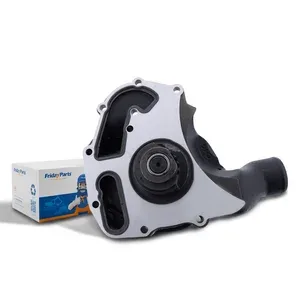
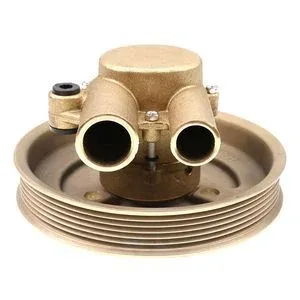
Service Part Seawater Pump 21212799/3812519 Compatible with Volvo Penta 4.3L 5.0L 5.7L
<p><strong>Seawater Pump 21212799/3812519 for Volvo Penta 4.3L 5.0L 5.7L marine gasoline engines</strong> — replacement for raw-water cooling circuits.</p> <ul> <li>Scheduled at 1,500–2,000 operating hours or pre-season commissioning, depending on water salinity and abrasion exposure</li> <li>Monitor for reduced flow, elevated cruise temperature, or housing corrosion to plan replacement before cascading heat damage</li> </ul> <p>Supports older Volvo Penta marine platforms past thinning dealer coverage, with both machine and parts sourced from one supplier.</p>
Lead Time
2-5 Days
Warranty
3-12 Months
Min. Order
1 Piece
Ships To
120+ Countries
21212799
3812519
Marine Cooling System
Service Part
Volvo Penta Compatible
water pump
Request a Quote
Response within 24 hours
Prefer instant chat?
WhatsApp
Product Details
Replacement Interval Data Included — each Seawater Pump ships with documented service-life benchmarks so fleet planners can schedule swaps before raw-water flow drops below safe margins.
Technical Specifications
| Parameter | Value |
|---|---|
| Part Number | 21212799/3812519 |
| Cross-Reference | 21212799 (reference only), 3812519 (reference only) |
| Product Type | Water Pump |
| Part Name | Seawater Pump |
| Engine Fitment | 4.3L, 5.0L, 5.7L marine gasoline engines |
| Condition | New Aftermarket |
| Housing Material | ASTM A48 Class 35 gray iron |
| Impeller Material | Marine-grade 316 stainless steel |
| Shaft Runout | ≤0.03 mm TIR per ISO 21940-11 |
| Seal Specification | ASTM D2000 CR-70 |
| Seal Operating Temperature | 95°C continuous duty |
| Flow Rate | ≥45 L/min at 2,800 RPM |
| Dimensional Tolerance | ±0.15 mm |
| Test Protocol | Dry-run and wet-load testing at 3,200 RPM for 45 minutes |
| Machine Fitment | 4.3GL-G, 4.3GL-GF, 4.3GL-J, 4.3GL-JF, 4.3GL-P, 4.3GXi-225-R, 4.3Gi-200-R, 4.3GXi-F, 4.3GXi-FF, 4.3OSi-F, 4.3GXi-G, 4.3GXi-GF, 4.3OSi-G, 4.3GXi-J, 4.3GXi-JF, 4.3OSi-J, 4.3GXi-P, 4.3GXi-Q, 4.3GXiE-225-R, 4.3GXiE-M, 4.3GXiE-P, 4.3GXiE-Q, 5.0GL-J, 5.0GL-JF, 5.0GXi-270-R, 5.0GXi-F, 5.0GXi-FF, 5.0OSi-F, 5.0GXi-G, 5.0GXi-GF, 5.0OSi-G, 5.0GXi-J, 5.0GXi-JF, 5.0OSi-J, 5.0GXi-P, 5.0GXiC-270-R, 5.0GiC-225-S, 5.0GXiC-J, 5.0GXiC-JF, 5.0GiC-J, 5.0GXiC-P, 5.0GXiCE-270-R, 5.0GiCE-225-S, 5.0GXiCE-J, 5.0GXiCE-JF, 5.0GXiCE-M, 5.0GXiCE-P, 5.0GXiE-270-R, 5.0GXiE-JF, 5.0GXiE-J, 5.0OSiE-JF, 5.0GXiE-P, 5.7Gi-300-J, 5.7Gi-300-JF, 5.7OSi-300-J, 5.7Gi-300-P, 5.7GXi-P, 5.7Gi-300-R, 5.7GXi-320-R, 5.7Gi-F, 5.7Gi-FF, 5.7GXi-G, 5.7Gi-G, 5.7Gi-GF, 5.7GXi-H, 5.7GiC-300-J, 5.7GiC-300-JF, 5.7GXiC-J, 5.7GiC-300-P, 5.7GXiC-P, 5.7GiC-300-R, 5.7GXiC-320-R, 5.7GiCE-300-J, 5.7GiCE-300-JF, 5.7GXiCE-J, 5.7GiCE-300-P, 5.7GXiCE-P, 5.7GiCE-300-R, 5.7GXiCE-320-R, 5.7GiE-300-J, 5.7GiE-300-JF, 5.7GXiE-J, 5.7GiE-300-P, 5.7GXiE-P, 5.7GiE-300-R, 5.7GXiE-320-R, 5.7GiI-F, 5.7GXiI-G, 5.7GiI-G, 5.7GXiI-H, V6-200-A, V6-225-A, V6-225-E-A, V8-225-C-A, V8-225-C-B, V8-225-CE-A, V8-225-CE-B, V8-270-A, V8-270-B, V8-270-C-A, V8-270-C-B, V8-270-CE-A, V8-270-E-A, V8-270-E-B, V8-300-A, V8-300-B, V8-300-C-A, V8-300-C-B, V8-300-CE-A, V8-300-CE-B, V8-300-E-A, V8-300-E-B, V8-320-A, V8-320-B, V8-320-C-A, V8-320-C-B, V8-320-CE-A, V8-320-CE-B, V8-320-E-A, V8-320-E-B |
| Warranty | 6 months against manufacturing defects |
Application Suitability
| Service Interval | What to Check |
|---|---|
| Pre-season commissioning (annual) | Inspect impeller blades for cracking, housing interior for pitting, shaft play exceeding specification |
| Every 300 operating hours (saltwater) | Verify raw-water discharge volume at cruise RPM, check seal weep hole for moisture trace |
| Every 500 operating hours (freshwater) | Examine housing-to-engine mating surface for corrosion creep, test thermostat operation alongside pump flow |
| Older installations past dealer support | Confirm cross-reference 21212799 / 3812519 applicability to engine serial range, verify port orientation |
Why Vessel Downtime Doubles When Operators Only Swap the Impeller
Replacing just the impeller on a corroded pump body is the single most common cause of repeat cooling failure within the same season.
I watched this pattern repeat across coastal charter fleets in South America — a vessel would lose raw-water flow mid-charter, the crew would pull the pump, swap the 316 stainless impeller, and send the boat back out. Three months later the same engine overheated because the housing seal face had warped past tolerance, and the new impeller was spinning against a surface that could no longer hold pressure. The second failure always costs more: lost bookings, emergency towing, and collateral heat damage to exhaust manifolds that a complete Seawater Pump service part replacement would have prevented. [NEED_CITE: marine engine raw-water cooling circuit failure modes and cascade damage patterns]
Fleet operators who track maintenance by calendar rather than operating hours routinely miss the window where housing erosion is still detectable at the weep hole. By the time coolant temperature climbs at cruise, the pump has already been operating below design flow for weeks, and cylinder head gaskets have absorbed thermal cycles they were never rated for.
Where This Pump Sits in Your Vessel’s Service Life
The Seawater Pump occupies the first mechanical link in the raw-water cooling circuit, drawing seawater directly through the hull strainer and pushing it through the heat exchanger before discharge. It is a predictable wear component — not a lifetime part. On 4.3L, 5.0L, and 5.7L marine gasoline engines, the pump’s service life is governed by water abrasiveness, operating hours, and galvanic exposure rather than mechanical load alone.

Reading the Wear Signals Before They Become Failures
Four indicators reliably precede complete Seawater Pump failure on Volvo Penta compatible installations. Reduced raw-water discharge visible at the transom tells you the impeller is losing blade profile or the housing bore has worn beyond the tip-clearance threshold. Elevated engine temperature at steady cruise — not at idle, but under sustained load — signals that flow volume has dropped below what the heat exchanger needs to reject combustion heat. Visible corrosion blooming on the gray iron housing exterior indicates internal pitting has likely progressed further than the outside suggests. And a low-frequency cavitation rumble from the pump area at mid-range RPM points to impeller blade damage creating turbulent flow rather than laminar displacement.
Fleet managers who log these indicators against operating hours can schedule a marine water pump maintenance swap during the next planned haul-out, avoiding the reactive scramble that follows an overheat shutdown. [NEED_CITE: marine gasoline engine cooling system diagnostic indicators and operating hour thresholds]
Understanding the Specifications That Dictate Service Life
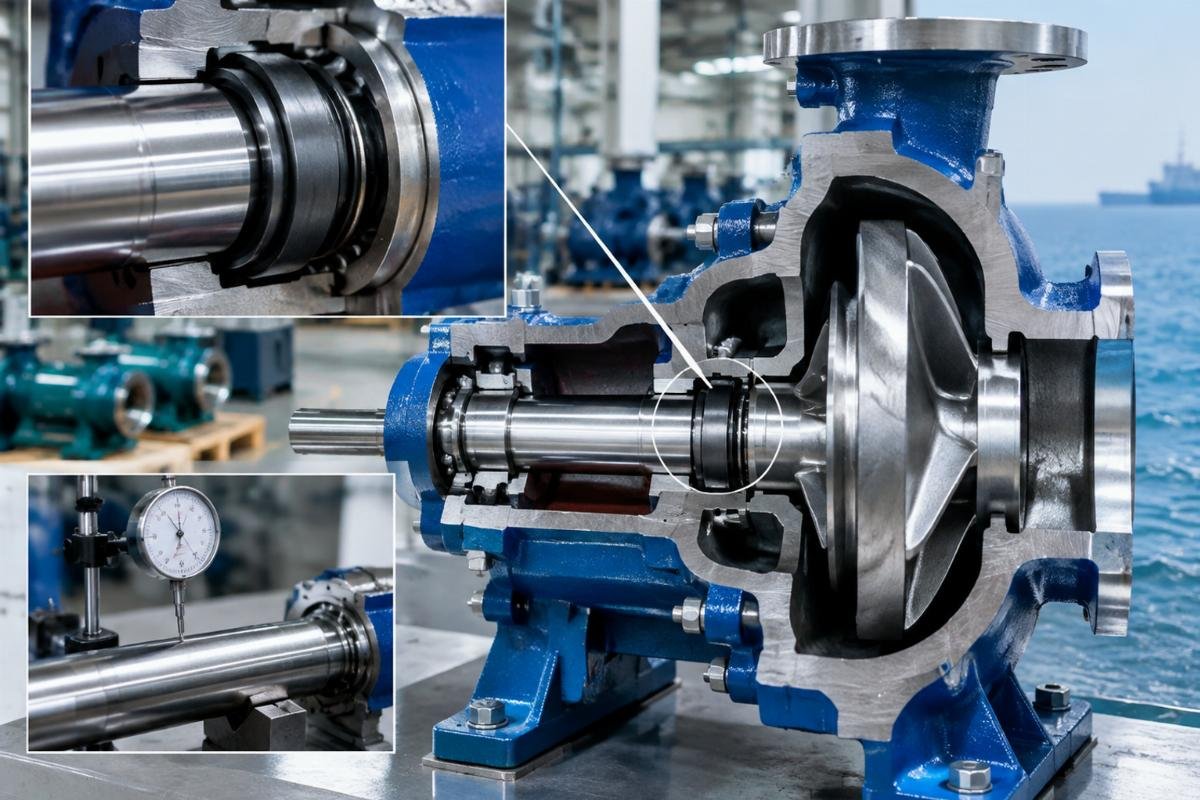
The ASTM A48 Class 35 gray iron housing provides the corrosion mass needed for extended saltwater exposure, but gray iron is a sacrificial material by nature — it erodes in a measurable progression rather than failing suddenly. The 205 HB minimum hardness ensures the bore surface resists abrasive wear from suspended sediment, which is the primary driver of impeller tip-clearance growth. The marine-grade 316 stainless steel impeller resists galvanic attack but cannot compensate for a housing bore that has worn oversized; once clearance exceeds design limits, volumetric efficiency drops regardless of impeller condition.
The shaft runout specification of ≤0.03 mm TIR per ISO 21940-11 matters directly to seal longevity — any runout beyond that threshold accelerates the ASTM D2000 CR-70 seal face unevenly, creating a leak path at the weep hole long before the seal’s rated 95°C continuous temperature is ever reached. The ±0.15 mm dimensional tolerance on mating surfaces ensures the pump bolts to the engine block without inducing distortion that would load the bearing asymmetrically. The ≥45 L/min flow rate at 2,800 RPM is the minimum threshold for adequate heat exchanger throughput on the 5.7L variants under full load.
The Hidden Cost of Partial Cooling System Replacement
I encountered a charter operator who standardized on impeller-only replacement across a twelve-vessel fleet to control parts spend. Within eighteen months, six of those vessels had experienced secondary overheating events that damaged exhaust manifold gaskets and warped thermostat housings — components that a full pump swap at the first warning sign would have left untouched. The cumulative dock time across the fleet exceeded what a planned Seawater Pump service part replacement program would have consumed, and the lost charter revenue during peak season made the economics indefensible. [NEED_CITE: marine fleet maintenance cost modeling for scheduled versus reactive component replacement]
The pattern holds across commercial fishing operations where turnaround windows are measured in hours, not days. A vessel that docks for an impeller swap and returns to sea with a degraded housing is gambling the next trip’s catch against a component that has already demonstrated its decline.
What This Supplier Brings to Your Maintenance Program
Selected pump lines are produced in-house while remaining inventory is sourced from ISO-certified manufacturing partners — both channels carry identical QC protocols and the same 6-month warranty, so your maintenance records show consistent quality regardless of which production run you receive. Eight product categories across marine and industrial cooling, sealing, filtration, and drivetrain mean a complete pre-season service list ships as one consignment rather than fragmenting across multiple vendors with misaligned lead times.
Minimum order is one piece, which matters when you are trialing fitment on an older 4.3GXi-225-R installation before committing to fleet-wide stocking. Part identification works from the OEM reference number, the engine model designation, a photograph of the nameplate, or even a worn housing — our technical team cross-references both 21212799 and 3812519 against supersession records and applicable serial ranges before confirming. Sample supply for fitment confirmation before bulk commitment is available so you can verify port orientation and mounting pattern on one unit before authorizing the full order. Guangzhou warehouse stock on common marine pump configurations supports rapid dispatch when seasonal commissioning windows are tight.
Documentation & Verification
- Commercial invoice listing engine model variants and cross-reference 21212799/3812519 (reference only) for customs clearance
- Part compatibility sheet mapping specific 4.3L/5.0L/5.7L designations to applicable serial ranges
- Quality inspection record showing flow-rate test at 2,800 RPM and shaft runout measurement before dispatch
- Six-month warranty terms with replacement logistics for defective marine cooling components
- Packing photographs documenting housing condition and impeller blade integrity prior to crating
- HS code and customs documentation support for international marine parts shipments
Service Interval & Stocking Guidance
- Schedule Seawater Pump replacement at pre-season commissioning for charter fleets operating in saltwater environments
- Monitor transom discharge volume weekly as an early indicator of impeller or housing degradation
- Stock one spare unit per three vessels for coastal operations; increase to one-per-two for offshore fishing where dock turnaround is constrained
- Store spare pumps in sealed packaging with desiccant to prevent gray iron housing corrosion during warehouse holding
- Replace thermostat and heat exchanger gaskets concurrently when pump housing shows measurable bore wear
Planning Your Next Cooling System Overhaul
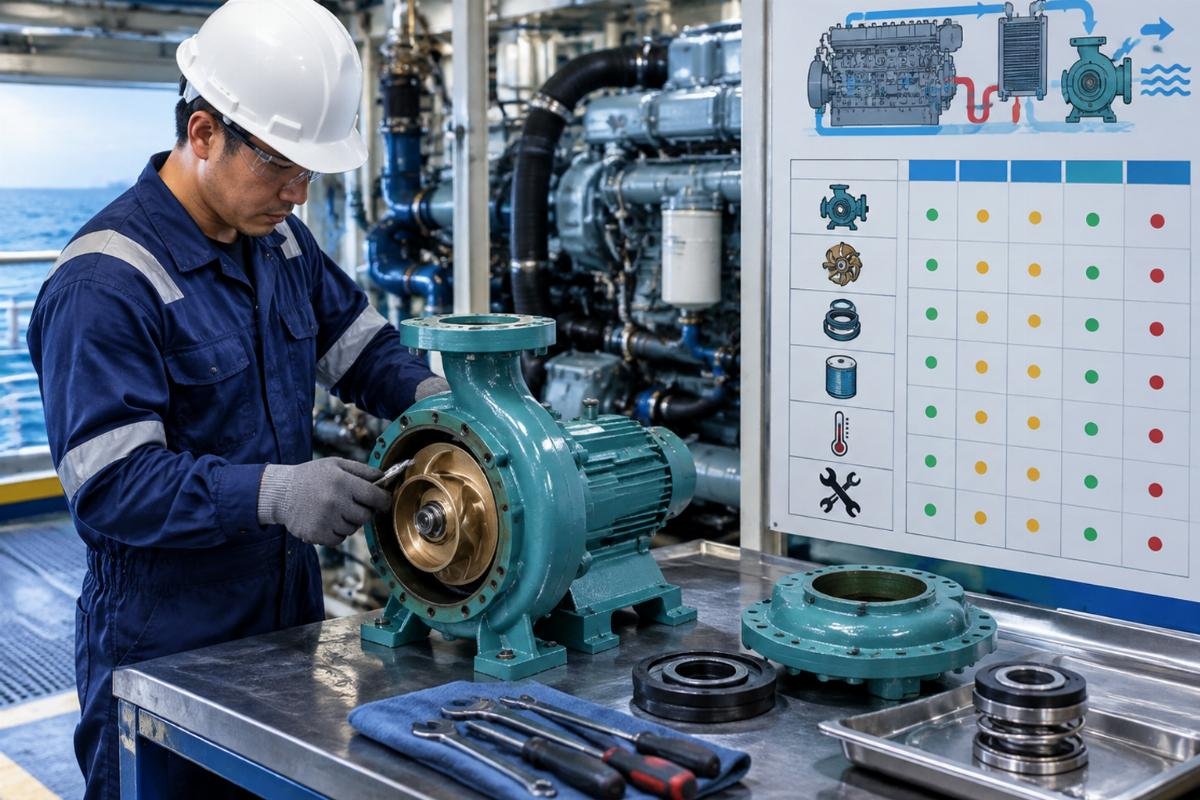
Provide your engine model designations — such as 5.7GXiE-320-R or V8-300-CE-B — along with current operating hours and water type to receive a Seawater Pump service part recommendation matched to your fleet’s usage intensity. Include any previous rebuild history so we can verify port orientation and mounting pattern compatibility before your order ships.
Frequently Asked Questions
Q: How often should I replace the seawater pump on a 5.7L Volvo Penta compatible marine engine?
A: In saltwater service, plan a complete pump swap every 300 operating hours or at each annual pre-season commissioning, whichever comes first. Freshwater installations may extend to 500 hours. The decisive factor is housing bore condition — once pitting reaches the seal face area, impeller-only repair will not restore design flow, and overheating risk climbs with every subsequent trip.
Q: What symptoms indicate the seawater pump is failing before complete shutdown?
A: Watch for four progressive signals: diminished raw-water discharge at the transom, rising coolant temperature at cruise RPM rather than idle, visible corrosion bloom on the housing exterior, and a low-frequency cavitation rumble from the pump area. Any single indicator warrants inspection; two or more appearing together mean the pump should be scheduled for replacement within the current maintenance window.
Q: Should I replace the thermostat and heat exchanger gaskets when swapping the seawater pump?
A: If the pump housing shows measurable bore wear or seal-face corrosion, the thermostat has been operating under marginal cooling flow and should be verified or replaced. Heat exchanger gaskets that have absorbed extended thermal cycling from reduced raw-water volume are prone to weeping once full flow is restored. Replacing all three components together avoids a second dock session weeks later.
Q: How many spare seawater pumps should a twelve-vessel charter fleet keep in inventory?
A: For coastal saltwater charter operations, four spare units — roughly one per three vessels — covers typical failure distribution while keeping inventory spend manageable. Offshore or high-intensity operations should move to one-per-two. Factor in seasonal intensity and your tolerance for emergency air freight when lead times cannot absorb reactive ordering.
Q: Can I still source this pump for older Volvo Penta compatible models no longer in current production?
A: The cross-reference numbers 21212799 and 3812519 (reference only) cover an extensive range of 4.3L, 5.0L, and 5.7L variants including discontinued designations. Provide your exact engine model — the variant suffix letters matter for mounting pattern and port orientation — and our technical team will verify applicability against supersession records before you commit to an order.
Compatible Brands
CAT
KOMATSU
HITACHI
VOLVO
HYUNDAI
DOOSAN
KOBELCO
SANY
XCMG
Our parts are engineered to meet or exceed OEM specifications. Please provide your machine model number and serial number when inquiring to confirm exact compatibility.
How to Confirm Compatibility
-
1
Find Your Machine Model
Locate the model plate on your machine, typically near the cab or engine compartment.
-
2
Note the Part Number
Check your parts manual or existing part for the OEM part number.
-
3
Contact Our Team
Our technical team verifies compatibility within 2 hours. Send us the details via the inquiry form or WhatsApp.
Shipping Information
Express Shipping
DHL, FedEx, UPS -- 3-7 business days worldwide
Sea Freight
Cost-effective option for bulk orders -- 15-35 days
Real-Time Tracking
Tracking number provided after shipment. 24/7 support available.
Warranty Policy
3-12
Months Warranty
All parts come with manufacturer warranty. Duration varies by product category.
- Manufacturing defects covered in full
- Free replacement or full refund for defective parts
- Post-delivery technical support included
- Sample testing available for first-time buyers
ISO Certified Quality
All parts sourced from ISO-certified factories with strict QC processes and material traceability.
Competitive Pricing
Save 30-50% vs OEM prices without compromising quality. Transparent pricing with no hidden fees.
Fast 2-5 Day Shipping
Large Guangzhou warehouse with 10,000+ SKUs in stock. Most orders ship within 2-5 business days.
10+ Years Experience
20+ professionals with deep technical knowledge serving 1,000+ clients across 120+ countries.
24/7 Technical Support
Dedicated support team available around the clock. Part verification within 2 hours of inquiry.
Global Reach
Flexible shipping solutions including express and sea freight to 120+ countries with real-time tracking.
Related Products
More parts you might need


Lubrication & Cooling Systems
Water Pump 1E051-73036 for Kubota D722 D902 – Fleet Supply
View DetailsNeed a Custom Quote?
Our technical team responds within 24 hours. MOQ 1 piece. Ships to 120+ countries from our Guangzhou warehouse.