

Lubrication & Cooling Systems

Lubrication & Cooling Systems
ISO Certified
Ships 2-5 Days
MOQ 1 Piece
Lubrication & Cooling Systems
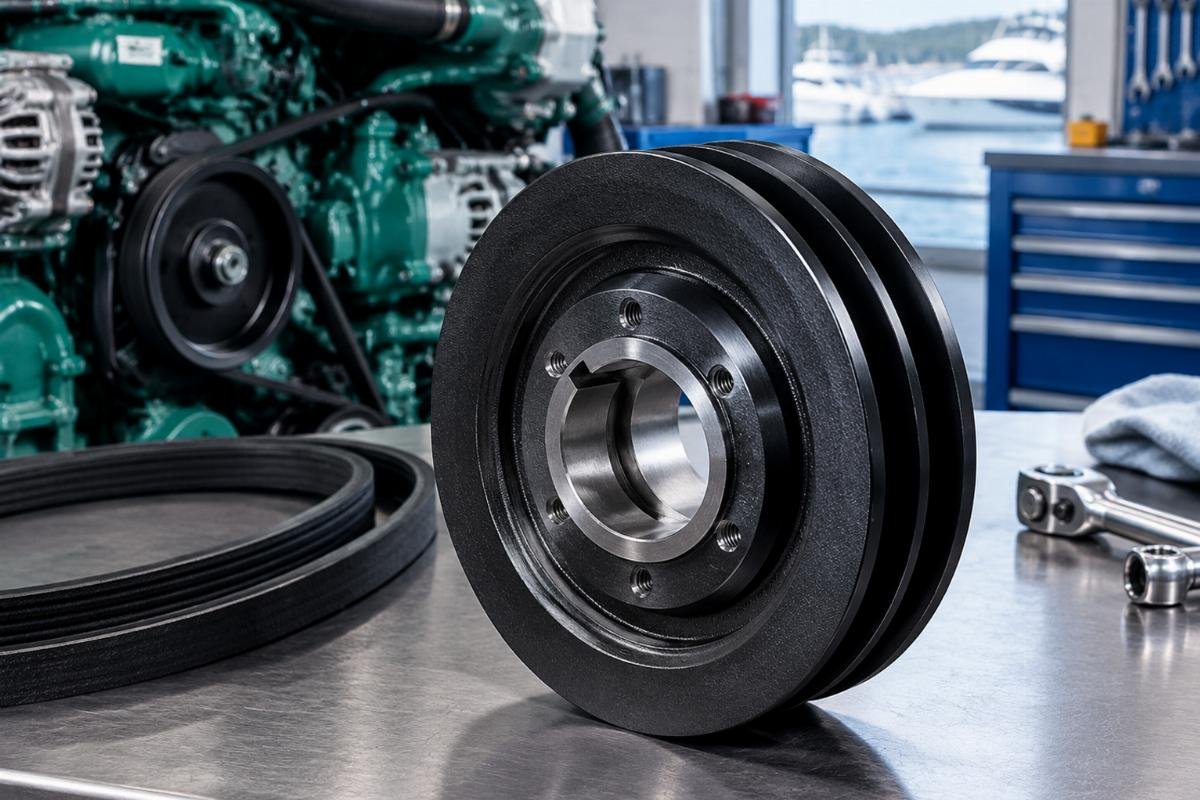
Double V-Belt Sea Water Pump Pulley for Volvo Penta – Service Part
<p><strong>Double V-Belt Sea Water Pump Pulley 21214596, 34° Groove, Cast Iron</strong> — replacement for Volvo Penta 4.3L, 5.0L, 5.7L marine engines in the cooling belt drive system.</p> <ul> <li>Worn groove surfaces cause belt slip, reduced seawater flow, and engine overheating; replacing the pulley alone restores drive performance without swapping the full pump assembly</li> <li>Phosphate and oil finish provides 96-hour salt spray resistance, suited for continuous marine exposure</li> <li>Cross-reference 21214596, 3858229, 3862487, 3812697 for identification</li> </ul> <p>Scheduled replacement intervals and wear inspection guidelines ship with every order to support your fleet maintenance plan.</p>
Lead Time
2-5 Days
Warranty
3-12 Months
Min. Order
1 Piece
Ships To
120+ Countries
21214596
Belt Pulley
Cast Iron
Double V-Belt
Service Part
Volvo Penta Compatible
Request a Quote
Response within 24 hours
Prefer instant chat?
WhatsApp
Product Details
Proactive Fleet Stocking — Cast iron pulleys with 96-hour salt spray resistance kept in rotation for Volvo Penta 4.3L, 5.0L, and 5.7L marine engine fleets.
Technical Specifications
| Parameter | Value |
|---|---|
| Part Number | 21214596 |
| Cross-Reference | 3858229, 3862487, 3812697 (reference only) |
| Product Type | Belt Pulley |
| Machine Fitment | 4.3GIJWTR, 4.3GiPEFS, 4.3GIPWTC, 4.3GIPWTR, 4.3GL-A/B/C/D, 4.3GLPEFS, 4.3GLPWTC, 4.3GLPWTR, 4.3GSJWTR, 4.3GSPWTC, 4.3GSPWTR, 5.0GiPEFS, 5.0GiPWTR, 5.0GL-A/B/C/D/E, 5.0GLPEFS, 5.0GLPWTR, 5.7GL-A/B/C/D/E, 5.7GSIPEFS, 5.7GSIPWTR, 5.7GSiPWTRCE, 5.7GSPEFS, 5.7GSPWTR |
| Brand Compatibility | Replacement for Volvo Penta |
| Material | High-strength cast iron |
| Groove Type | Double V-belt, 34° included angle |
| Runout Tolerance | ≤0.05 mm |
| Surface Hardness | 220–240 HB |
| Surface Treatment | Phosphate + oil anti-corrosion finish |
| Salt Spray Resistance | 96-hour neutral salt spray (NSS) per ASTM B117 |
| Assembly State | New Aftermarket |
| Certification | ISO 9001 |
| Warranty | 6-month manufacturer defect warranty |
| MOQ | 1 piece |
Application Suitability
| Service Interval | What to Check |
|---|---|
| Every 100–200 operating hours or annual haul-out | Groove surface for glazing, belt edge fraying, pulley runout |
| Seasonal commissioning after winter layup | Corrosion pitting in V-grooves, belt tension and alignment |
| During seawater pump impeller replacement | Pulley bore condition, keyway wear, set screw engagement |
| Engine overhaul or repower planning | Full belt-drive component audit including tensioner and idler |
| Transition from fresh to brackish/saltwater routes | Accelerated corrosion inspection on all exposed drive surfaces |
Why Fleets Replace Pulleys After the Engine Has Already Overheated
Schedule pulley swaps at the haul-out, not at the breakdown.
On charter routes across the Caribbean and Gulf of Mexico, I have watched crews lose entire fishing seasons because a corroded double V-belt seawater pump pulley was overlooked during routine maintenance. The pulley groove surfaces wear smooth over time, the belt starts slipping under load, and seawater flow drops below what the heat exchanger needs. By the time the alarm sounds, exhaust manifold cooling is already compromised. [NEED_CITE: marine engine seawater cooling system maintenance intervals]
Most operators treat this Double V-Belt Sea Water Pump Pulley service part as a reactive purchase — ordered only after the belt has thrown or the pulley has cracked at the hub. That pattern guarantees unplanned downtime during peak revenue windows. A fleet with multiple Volvo Penta 4.3L, 5.0L, or 5.7L units should calculate pulley consumption across all engines and stock accordingly, replacing on schedule rather than on failure.
Where This Pulley Sits in the Engine Service Life
The belt drive for the seawater pump occupies a critical but often neglected position in the marine engine maintenance cycle. Unlike the main circulation pump driven directly by the crankshaft, this pulley transmits power through a belt that is exposed to salt spray, bilge moisture, and thermal cycling from the engine compartment. Over hundreds of operating hours, the Double V-Belt Sea Water Pump Pulley service part experiences groove erosion that is invisible until belt slip becomes audible.
Fleet operators who manage preventive maintenance programs know that pulley replacement should coincide with belt changes and tensioner inspection. Replacing only the belt while leaving a glazed pulley in place cuts the new belt’s service life dramatically. The pulley, the belt, and the tensioner form a single wear system, and servicing them as a group prevents the repeated short-interval failures that plague operators who swap components one at a time. [NEED_CITE: belt drive system component interaction in marine diesel engines]
Recognizing Wear Before the Belt Fails
Three symptoms reliably indicate that this pulley has reached its replacement point. First, a high-pitched squeal during engine start-up that fades after warm-up means the belt is slipping on polished groove surfaces. Second, belt edge fraying visible during routine inspections shows that groove wear has altered the contact geometry. Third, seawater discharge temperature trending upward over successive trips signals reduced pump speed from belt slip.
Each of these symptoms develops gradually, which is precisely why they get missed during quick pre-departure checks. A structured inspection protocol at scheduled haul-outs or winter layups catches groove wear early. Phosphate and oil surface treatment on this replacement pulley provides a corrosion-resistant starting point, and the 220–240 HB surface hardness resists groove polishing under normal belt tension. Operators who track these wear indicators across a fleet can forecast replacement timing and consolidate orders rather than making emergency purchases at a premium.
What the Specification Numbers Mean at Sea
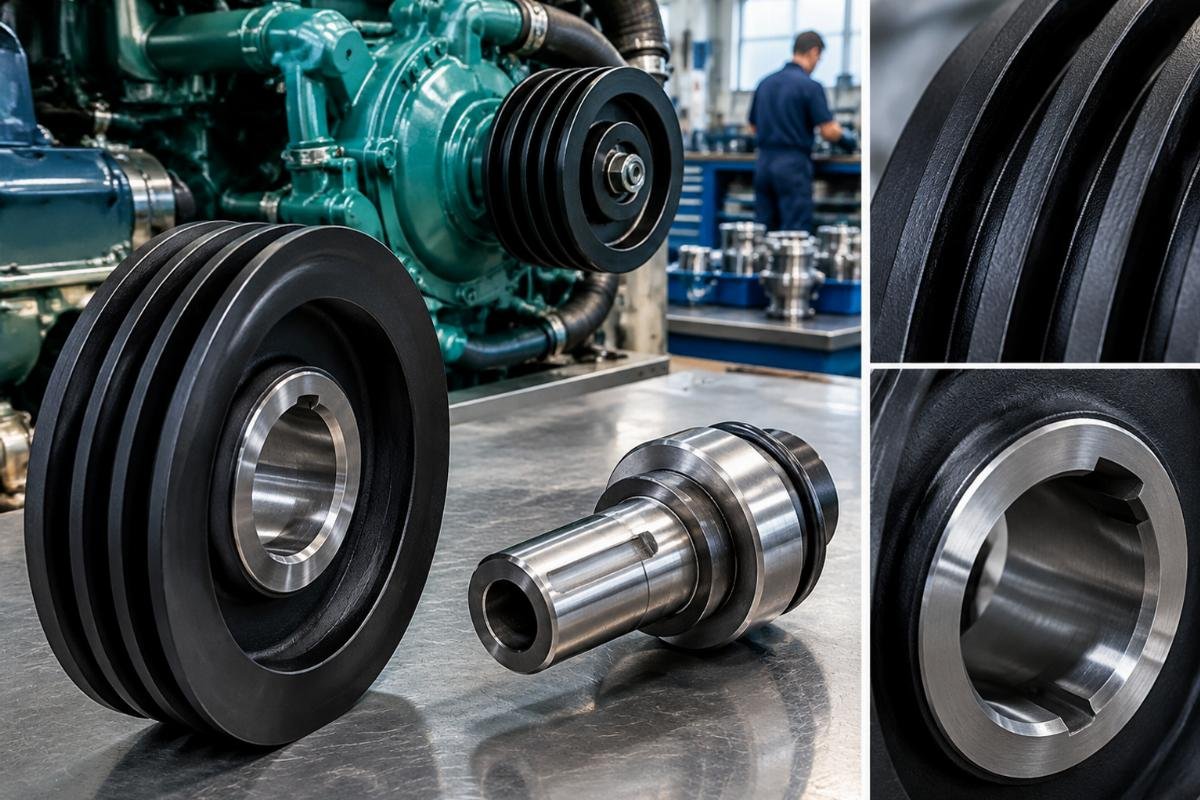
The 34° included angle on the double V-groove must match the belt profile precisely — a mismatch causes the belt to ride high in the groove, reducing contact area and accelerating wear on both components. The ≤0.05 mm runout tolerance ensures that the pulley spins true at engine RPM, preventing the cyclic tension variation that fatigues belt cords and produces the harmonic vibration felt at the steering station.
High-strength cast iron provides the mass needed to dampen torsional pulses from the crankshaft while resisting the galvanic corrosion that attacks aluminum pulleys in saltwater environments. The 96-hour neutral salt spray rating per ASTM B117 confirms that the phosphate and oil finish provides meaningful protection during storage and the early weeks of service, even in engine compartments where salt air intrusion is constant. For engines operating in tropical or subtropical waters, this corrosion resistance extends the window between inspections. [NEED_CITE: ASTM B117 salt spray testing relevance for marine engine components]
The Cost of Waiting Until the Belt Throws
Reactionary procurement of a single pulley after belt failure rarely ends the repair story. The belt that slipped on a worn pulley has already sustained internal cord damage, even if it appears intact. Installing that compromised belt on a new pulley leads to premature belt failure, forcing a second haul-out or a dockside repair that disrupts the charter schedule. [NEED_CITE: belt drive failure cascades in marine propulsion systems]
For fleet operators, the cumulative effect compounds across vessels. Each unscheduled repair pulls a mechanic from planned maintenance, delays the next departure, and erodes customer confidence in the operation. Stocking this Double V-Belt Sea Water Pump Pulley service part in the fleet parts room — alongside matched belts and tensioner assemblies — converts an emergency into a scheduled swap completed during a routine service window.
Why Sourcing This Part Here Works for Fleet Planning
Both self-produced and qualified sourced supply lines carry the same QC standards and warranty terms, so fleet buyers can consolidate engine drive components under a single account without juggling multiple vendor relationships. Eight product categories — from belt drive components to seal kits and electrical parts — allow a complete haul-out parts list to ship as one consignment, eliminating the split-freight problem that delays maintenance windows.
One-piece minimum order quantity supports operators who need a single replacement for an outboard station engine, while volume pricing applies when stocking across a fleet of trawlers or ferries. Part identification from engine model alone — even when nameplates are painted over or corroded — resolves the common problem of ordering the wrong variant for early-production 4.3L or 5.7L engines. Cross-reference verification covers superseded numbers like 3858229 and 3862487, preventing the mismatches that arise from copied reference tables. Sample supply allows fitment confirmation on a single engine before committing to fleet-wide stock levels, and the technical team confirms compatibility across the full range of GL, GI, GS, and GSI variants.
Documentation & Verification
- Commercial invoice and packing list with pulley part number and engine fitment cross-reference
- Compatibility sheet mapping cross-reference numbers 3858229, 3862487, and 3812697 (reference only)
- Dimensional inspection record covering groove angle, runout, and bore diameter before dispatch
- Six-month warranty terms covering manufacturing defects in cast iron and surface treatment
- Packing photographs showing corrosion-protective wrapping for salt-air transit environments
- HS code and customs documentation support for marine parts import clearance
Service Interval & Stocking Guidance
- Inspect groove surfaces for glazing and pitting at every annual haul-out or 200-hour service
- Replace pulley and belt as a matched set; never install a new belt on a polished groove
- Stock one pulley per two engines for charter fleets operating in saltwater environments
- Store spare pulleys in sealed packaging with original phosphate-oil coating intact until installation
- Record groove condition and belt replacement dates in fleet maintenance logs for trend analysis
- Rotate stocked pulleys into service within the warranty period to maintain coverage eligibility
Planning Your Next Haul-Out Parts Order
Provide your engine model designations — such as 5.7GSPWTR or 4.3GLPWTR — along with current operating hours and the date of your last belt-drive service. This allows us to confirm variant compatibility across your fleet and recommend stock quantities aligned with your maintenance schedule.
Frequently Asked Questions
Q: How often should I inspect the seawater pump pulley on my Volvo Penta marine engine?
A: Inspect groove surfaces, runout, and bore condition at every annual haul-out or every 100–200 operating hours, whichever comes first. Charter vessels operating daily in saltwater should check at the shorter end of that range. Look for glazing on the V-grooves, corrosion pitting, and any visible wobble during a slow engine crank.
Q: Is belt slip always caused by a worn pulley, or could it be the belt itself?
A: Belt slip can originate from either component or from a failing tensioner. Check the pulley groove surfaces first — if they appear polished smooth rather than matte, the pulley is the root cause. A belt with frayed edges and intact grooves on the pulley points to belt age. Always diagnose the entire drive system before ordering replacements.
Q: Can I replace just the pulley and keep the existing belt?
A: You can, but it is not recommended if the belt has been running on a worn pulley. Belt cords sustain internal damage from slipping that is not visible externally. Installing a suspect belt on a new pulley risks early belt failure and a second unplanned service event. Replace both as a matched set during scheduled maintenance.
Q: My Volvo Penta model is an early-production variant. Will this pulley still be available in future years?
A: This aftermarket pulley covers the full range of 4.3L, 5.0L, and 5.7L variants including early GL, GI, and GS series engines. As an independent supplier with ongoing production and sourcing arrangements, we maintain availability regardless of whether the original equipment manufacturer continues to support older model designations.
Q: How many spare pulleys should a charter fleet keep on the shelf?
A: A practical starting point is one pulley for every two engines in the fleet, assuming annual haul-out inspections. Fleets operating in highly corrosive tropical saltwater environments may increase that ratio. Factor in lead times for reorder and the cost differential between planned stocking and emergency single-piece purchases when setting your threshold.
Compatible Brands
CAT
KOMATSU
HITACHI
VOLVO
HYUNDAI
DOOSAN
KOBELCO
SANY
XCMG
Our parts are engineered to meet or exceed OEM specifications. Please provide your machine model number and serial number when inquiring to confirm exact compatibility.
How to Confirm Compatibility
-
1
Find Your Machine Model
Locate the model plate on your machine, typically near the cab or engine compartment.
-
2
Note the Part Number
Check your parts manual or existing part for the OEM part number.
-
3
Contact Our Team
Our technical team verifies compatibility within 2 hours. Send us the details via the inquiry form or WhatsApp.
Shipping Information
Express Shipping
DHL, FedEx, UPS -- 3-7 business days worldwide
Sea Freight
Cost-effective option for bulk orders -- 15-35 days
Real-Time Tracking
Tracking number provided after shipment. 24/7 support available.
Warranty Policy
3-12
Months Warranty
All parts come with manufacturer warranty. Duration varies by product category.
- Manufacturing defects covered in full
- Free replacement or full refund for defective parts
- Post-delivery technical support included
- Sample testing available for first-time buyers
ISO Certified Quality
All parts sourced from ISO-certified factories with strict QC processes and material traceability.
Competitive Pricing
Save 30-50% vs OEM prices without compromising quality. Transparent pricing with no hidden fees.
Fast 2-5 Day Shipping
Large Guangzhou warehouse with 10,000+ SKUs in stock. Most orders ship within 2-5 business days.
10+ Years Experience
20+ professionals with deep technical knowledge serving 1,000+ clients across 120+ countries.
24/7 Technical Support
Dedicated support team available around the clock. Part verification within 2 hours of inquiry.
Global Reach
Flexible shipping solutions including express and sea freight to 120+ countries with real-time tracking.
Related Products
More parts you might need

Lubrication & Cooling Systems
Sea Water Pump for Volvo Penta 4.3L 5.0L 5.7L – Service Part
View Details
Lubrication & Cooling Systems
Water Pump with Gasket for CASE IH Tractors 234–1140, Direct Replacement
View Details
Lubrication & Cooling Systems
Water Pump 1G772-73032 for Kubota V3307 Engine – Direct Replacement
View DetailsNeed a Custom Quote?
Our technical team responds within 24 hours. MOQ 1 piece. Ships to 120+ countries from our Guangzhou warehouse.